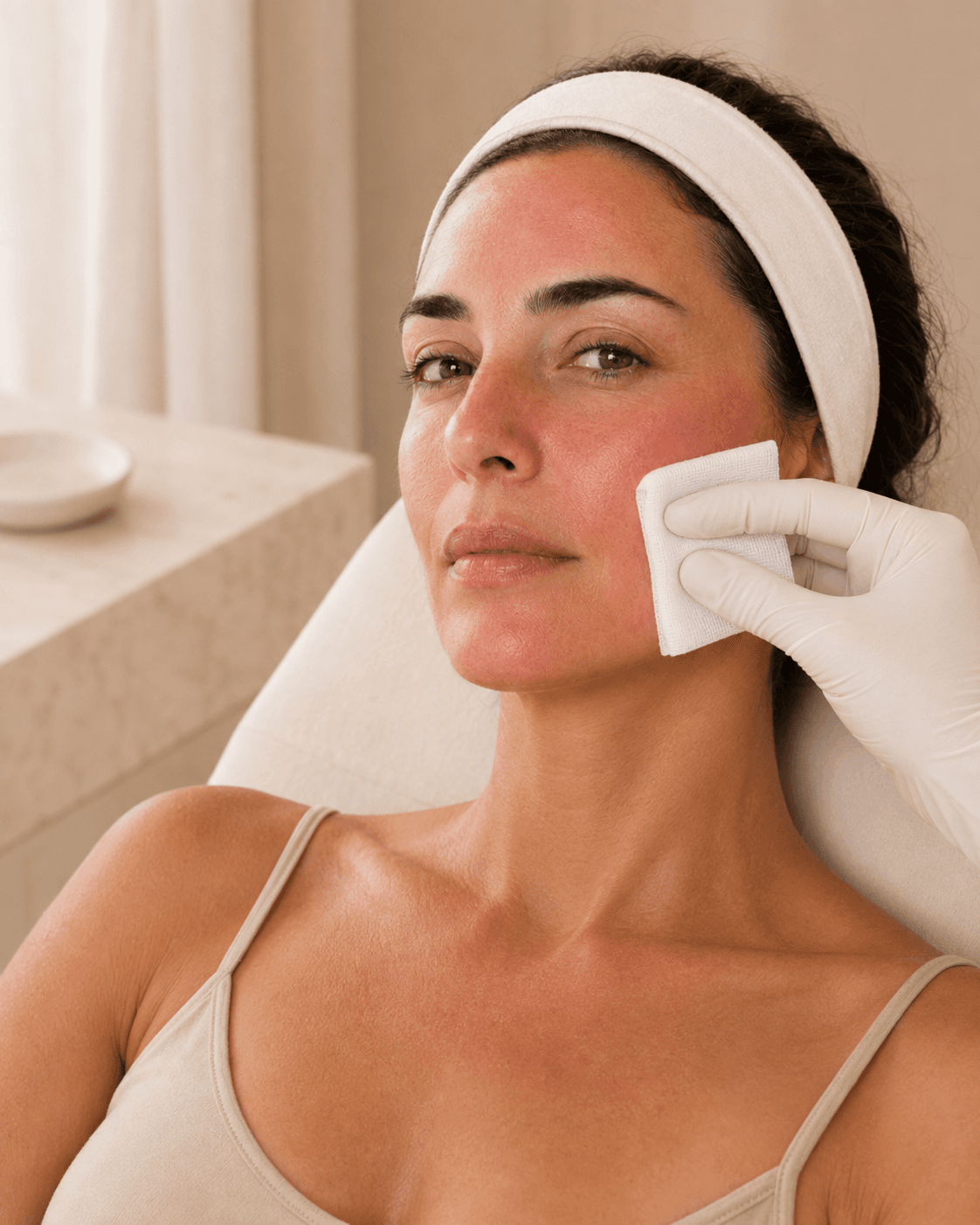
UV protection remains essential, but for pigment-prone skin the visible part of sunlight may matter too.
Melasma is an acquired pigmentary condition that most often appears as symmetrical brown or grey-brown patches on the face. Its biology is complex. Genetics, hormones, ultraviolet radiation, visible light and local skin signalling may all contribute. Because triggers differ between individuals, melasma should not be reduced to a simple consequence of “too much sun.”
Visible light is the part of the electromagnetic spectrum the human eye can see, roughly 400 to 700 nanometres. Experimental studies have shown that visible light can induce pigmentation, particularly in darker skin phototypes. In one study, visible-light-induced pigmentation in skin types IV to VI was darker and more persistent than pigmentation induced by UVA1 at the tested doses. Other work suggests that blue-violet wavelengths are especially relevant, but laboratory exposure protocols do not perfectly reproduce ordinary daily life.
This matters because a sunscreen can provide excellent UV protection without attenuating much visible light. Organic UV filters and transparent mineral sunscreens are designed primarily around UV wavelengths. Tinted products containing pigments such as iron oxides can reduce transmission in parts of the visible spectrum.
Clinical evidence supports this distinction. In a randomised study of 68 people with melasma, both groups used sunscreen alongside hydroquinone, but the group assigned a formula protecting against UV plus visible light showed greater improvement than the group using UV-only protection. The visible-light formula contained iron oxide. This does not mean every tinted sunscreen will treat melasma, or that iron oxide concentration and shade are interchangeable across products.
Management usually requires more than sunscreen. A dermatologist may consider topical agents, procedures or changes related to hormones and medication, depending on the person. Irritation can worsen pigment in some skin types, so aggressively layering acids, retinoids and bleaching agents without guidance may be counterproductive.
A careful routine begins with broad-spectrum UV protection, shade and a hat. For people with melasma or persistent hyperpigmentation, a well-formulated tinted sunscreen with visible-light-attenuating pigments may offer an additional benefit. The best product is one that matches the skin tone, is tolerated and is applied in an adequate, even layer.